


I put a shout out to subscribers about what topics they might want me to look into, and got a response:
“Perhaps a bit more on OCD (I know not a favoured word in 3P)”
The request—“Perhaps a bit more on OCD”—immediately got sent to the back burner (rather than turning into a Daily Reminder), and I found myself wondering more about the second bit of the sentence—“not a favoured word”—instead.
Because it occurred to me that I don’t tend to write that much about specific conditions (or ‘patterns of behaviour’ shall we say)… which could be construed as ‘not favoured’ by me, either.
And I’ve spent more time wondering about that, than thinking about OCD itself 😆
The origin of diagnoses
The answer lies in the image below. From the first time of reading this, from Richard Carlson, it made total sense to me:
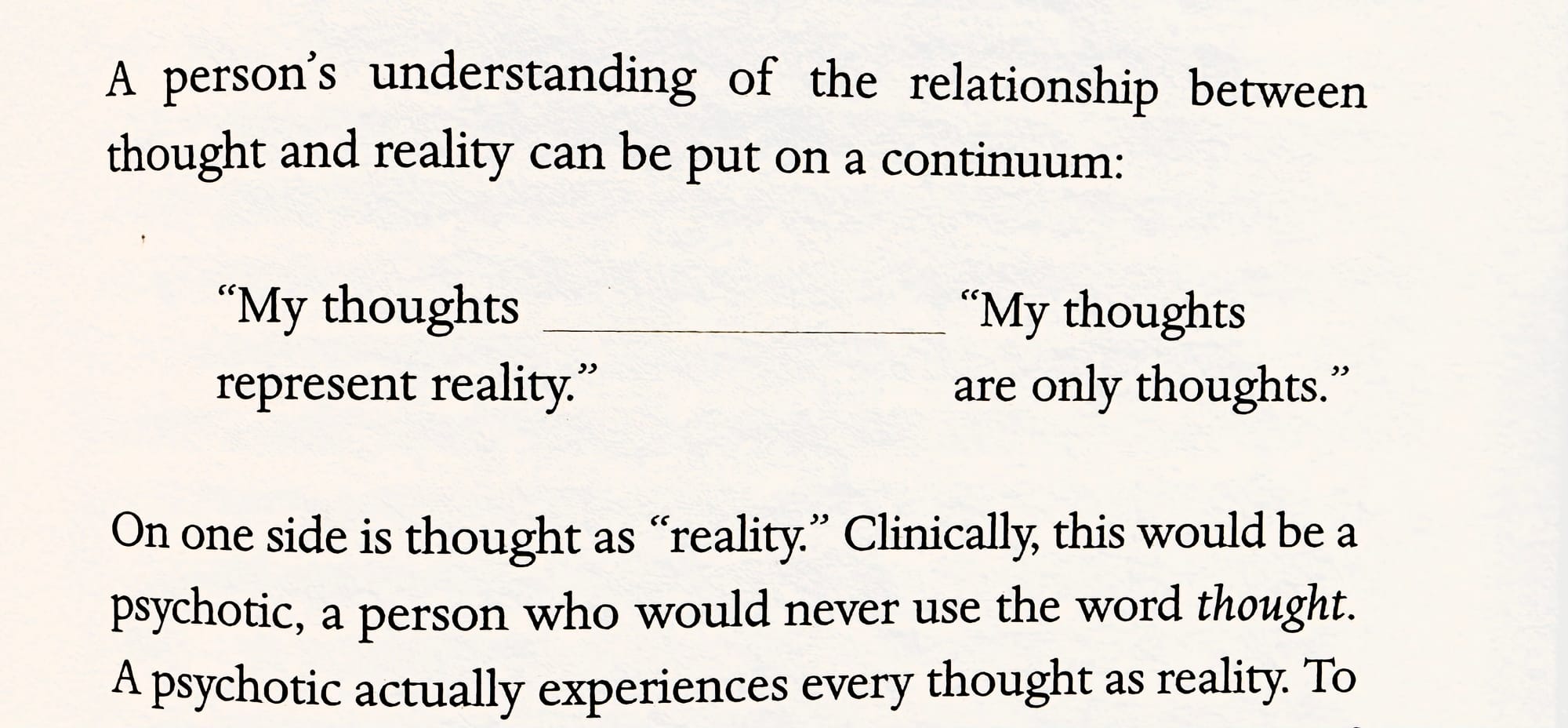
Given that the entirety of our felt experience of life, in each moment, is being created from thought-perception, then it makes sense that the quality of that experience is going to be determined by how we relate to that thought/feeling creation.
Put very simply, at one end of this spectrum (seeing thought as real but not true) we find unobstructed innate ‘mental health’ and at the other end of it (seeing thought as gospel, going unquestioned) we find the same innate mental health that's clouded by a ‘dis-ordered’ relationship to thinking.
How that ‘dis-order’ shows up is unique to each of us, because we’ve all got different genetics and had different upbringings (i.e. nature and nurture). But of course we also have shared mythological learnings—like maps we use—as a species, and as cultures within that species, so inevitably we will encounter observable, similar patterns of ‘dis-ordered’ behaviour.
And here in the 21st Century Western World, that translates to ‘diagnoses’. Of which OCD (‘Obsessive-Compulsive Dis-order’ ) is one.
Simplicity vs. Detail
If we look dispassionately at all of this we'll see that:
- Things begin with how we relate to the thought/feeling creation (i.e. this is what lies upstream)
- And how dis-order shows up, or the pattern of behaviour that we call a ‘diagnosis’, is the end-product of that (i.e. symptoms lie downstream of our relationship to thought)
It therefore makes sense—if we want to see a change in the dis-order, diagnosis, or symptoms—to look not at the dis-order itself, but at where it's coming from.
Getting a better relationship to our thinking in general, is not only a more effective approach to mental health conditions, it's a lot more simple, too! (I am a simple chap.)
That's why Syd Banks said:
“Look for simplicity. Simplicity always holds the key you're looking for. And that key… it opens the door to wisdom.”
But of course, here in the 21st Century Western World—the world of psychiatrists, therapists, self-help, social media ‘experts’ & personal development—we have a tendency to look more and more at the detail, trying to manage our behaviour, using ever more complex tools and techniques (and drugs).
We're looking in the wrong direction, and I can pretty much guarantee that anyone who comes to me with one such diagnosis, has become a real expert in it themselves. They'll know all about the detail, and will have done a ton of reading, researching and thinking about it… when (unfortunately; innocently) that's the very thing that's holding it in place.
Not favoured vs. Not helpful
So when it comes to very real, very debilitating conditions like OCD, it's not so much that talking about it or addressing it is frowned upon, or ‘not favoured’, it's just that it's not actually that helpful.
Directing our attention to the end product; to the diagnosis; to the behaviour or the ‘problem’ and trying to make changes from there is utterly futile, and will keep us stucker than a stuck thing covered in velcro.
All that said… in the next Daily Reminder, I'm going to look at a real life example of someone who ‘overcame’ OCD when they were introduced to the Innate Health/3 Principles understanding.
But this needed saying first: a bit of contextual FOUNDATIONS for you.
Stay tuned!
💟
Giles
Related
 Giles P Croft
More on the power of looking upstream