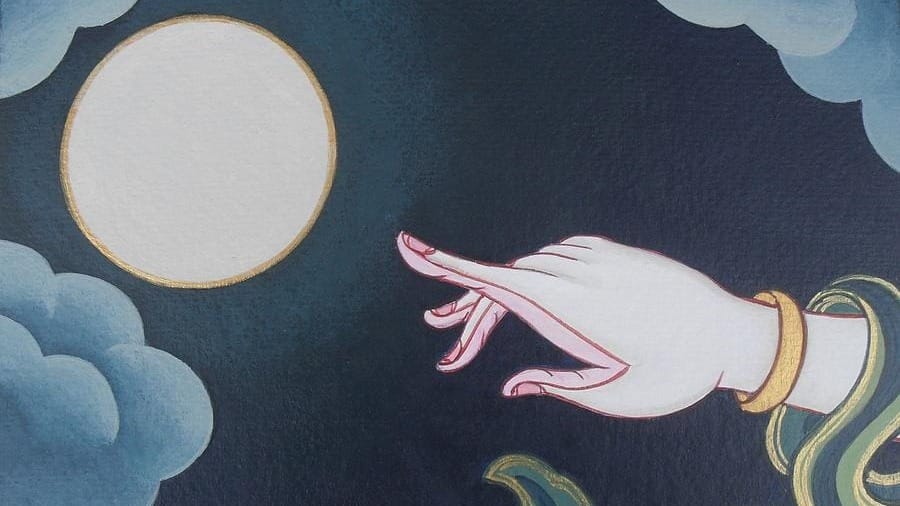
The other day I wrote a piece about insights – how they're different from intellectual knowledge and how they come to us from outside of our current understanding of things.
(Between you and me I was very pleased with the image I created for that one! 🤣)
And I can tell you, it's bloody hard to write about such things… specifically because what we’re talking about lies outside of our frame of reference. We’re using the tools of the left brain (separation, language, categorisation) to describe something that’s essentially formless. An ‘unknown unknown’ as I put it.
(Case in point: the image of the Thought System floating in space. I had racked my brains for a suitable image to denote ‘unknown unknowns’ and all the Giles Ego Construct 📦 could come up with from its filing system was pictures of question marks, or—worse still—an image of Donald Rumsfeld! 😱 And then when I stopped trying and got on with something else, this visual imagery popped into my head. Form, from formless, you see?)
Asking Syd
The good news is, there was someone who became rather good at this whole pointing-to-the-formless malarkey, and that of course is Sydney Banks. The Scottish welder, seeker and latter day mystic, without whose insights the Daily Reminders would not exist. (Most of my teachers in recent times have been students of his, directly or indirectly.)
So when I was writing that piece the other day, I pulled his book The Missing Link off the shelf, to see what nuggets of wisdom it contained, on the topic of insight.
Most of Syd’s books were written in novel form (The Enlightened Gardener pair are my favourites, and not just because the first has a quote from Richard Carlson on its cover!) but The Missing Link is different. Subtitled Reflections on Philosophy & Spirit, it’s one to keep at arm’s reach and just dip into, to see what will resonate for you today.
There’s no chapter specifically on ‘insight’ but the word is pretty much synonymous with ‘wisdom’ and there’s definitely a chapter on that. You can mentally substitute one for the other, in then passages below, if you like.
Here’s how he articulates this notion of ‘unknown unknowns’ – firstly outlining why I found that Daily Reminder so tricky to write:
“No one can give away wisdom. A teacher can only lead you to it via words, hoping you will have the courage to look within yourself and find it inside your own consciousness… Beyond the word.”
Yup. I’ve said before, all I’m ever trying to do here at Daily Reminders Central 🏢 is point you towards something – not tell you about something.
Looking ‘within’
But what does he mean by ‘within yourself’? Doesn’t that mean thinking about stuff? No it doesn’t, and he’s quite specific about this:
“Intellectual observation is ego, after form. Wisdom is found before the formation of form.”
So our thinking actually sits in the ‘form’ camp – it might be ethereal and capricious and not ‘true’, but it’s still observable and is something you experience, therefore it has a form.
It was years after I’d come across the 3 Principles before this clicked for me. I’d been labouring under the impression that ‘form’ in this context meant something material, that I could touch, but it doesn’t. That was another insight that shifted my perspective entirely, and had me revisiting all of Syd’s work!
Here again, he’s very clear:
“That which you seek has no form. If you attempt to put a shape on the formless, you will never find it. Attempt to describe the formless with words, and the word turns the formless into form, creating an illusion and leading you further away from that which you seek.”
(Honestly, this book is pure gold! 💛)
So in this way, insight, and solving problems (like what image to put on a Daily Reminder post, or how to talk to your boss or partner without being at loggerheads with them, or how to get out of a persistent emotional state) have nothing to do with ‘racking our brains’ – that’s looking in the wrong direction.
“The solutions to outwardly complex problems created by misguided thoughts will not arise from complicated analytical theory, but will emerge as an insight, wrapped in a blanket of simplicity.”
And here, in the very simplest of terms:
“Wisdom brings common sense to those who find it.”
😙👌🏻
I really do recommend that you sit and read this wonderful book.
- If you already have a copy, pull it down off the shelf and dip into it again.
- If you don’t yet have a copy, get hold of one.
- And if you can’t afford a copy, the entire thing is available for free in PDF version on the Sydney Banks website.
Last words go to Syd in helping you to remember the caveat, when you’re reading:
“Seek without seeking, for what you hope to attain is already within you.”
💖
Giles
p.s. You might like to go back and read this one again, now → How to solve any problem.
Related
 Giles P Croft