In my new part-time job, I work with dads, so it makes sense that I would read the brilliant ‘Life of Dad: The Making of the Modern Father’ by Dr Anna Machin.
Anna is an evolutionary anthropologist who’s looked at why dads have evolved to be how they are (we are the only primate that has devoted, child-nurturing fathers), and what that means in the 21st Century, across all sorts of different cultures.
For a spod like me, learning about the biological imperatives behind things like rough-and-tumble play, emotional connection and even monogamy, doesn’t feel like ‘work’ – it’s fascinating!
🤓
Anyway, as she outlines at the beginning of the book, one of the main reasons she entered this field in the first place, was because she experienced a fairly traumatic childbirth, from which she managed to heal psychologically, but her husband didn’t.
Plagued by flashbacks—held in place partly by the guilty thought: “But nothing happened to me!”—he didn’t get the help he needed, because, well, because dads get a bit overlooked, don’t they?
Hence my new role.
There are three of us Dads Advisors, and as we got to know each other, we learned that we’ve all got our own traumatic stories from the delivery suite, so it’s not uncommon.
In Life of Dad, Anna details:
- Dads who experienced deeply traumatic childbirth scenarios with their partners… but ultimately were fine
- And dads who experienced textbook, ‘straightforward’ childbirth, but went on to suffer from PTSD, having witnessed their partners in such pain.
…and wonders, Why?
Personality peril
What follows in the book is an exploration of personality traits—i.e. what patterns of behaviour tend to emerge from people’s Thought Systems—along with an overview of the causes of personality (‘Nature & Nurture’ – it’s not rocket science) and then an examination of the kinds of people with personalities that tend to either:
- move on from traumatic experiences, essentially forgetting them, or
- continue to struggle with the memory of them, sometimes to a debilitating extent.
So far, so Psychology 101, for anyone who’s dabbled in the subject. (Can I get a ‘label to go’ with that, please? 😉)
Then, Anna offers hope, suggesting that she’s met plenty of dads who’ve seemingly overcome their biology and their upbringing to become the most wonderful fathers, in spite of (or maybe by prevailing over) their personality traits – hinting that personality might not be quite as fixed as we believe it to be… but then not taking this notion any further, as it's a bit beyond the scope of the book.
Let’s take this notion further
Four months ago, in a Daily Reminder I wrote on the subject of introversion, I suggested that personality was “all made up” (my exact words), and rather petulantly sped off to perform an MBTI personality test on your behalf, before returning to report the results:
“I came back as an ISFP (‘The Adventurer’) with allegedly suitable careers such as Writer, Social Worker, Counsellor and Musician”
I then said I’d forget that immediately because in a different frame of mind (or level of consciousness), I’d get totally different results.
As I started writing this piece, I remembered I'd done this, so just now I toddled off and answered the exact same 93 questions again… you know, just to check I'm definitely in the right job and all that.
🤨
I swear, I answered everything as truthfully as I possibly could (just like I did last time), although—again—I found it to be quite contradictory in places, sometimes agreeing quite heartily with both sides of a measure, as I envisaged myself in different scenarios.
And what did I find?
This time I'm apparently an ESTP (‘The Promoter’) and should be a Sales Rep, an Entrepreneur, a Policeman or a Firefighter.
Uh oh. Not only have I had a personality change in just four months, but now I'm also in the wrong job!!
That said, I'd still argue that the degree to which I exhibit Openness to experience, Conscientiousness, Extraversion, Agreeableness and Neuroticism depends entirely on the state of mind I'm in, in each given moment!
It's much more than that
But I'm just messing here, because this is, of course, another example of us trying to study or measure something (Psychology; Thought) by using that same something (Psychology; Thought) as our measuring tool.
It's the very definition of chasing your tail!
🤦🏻♂️
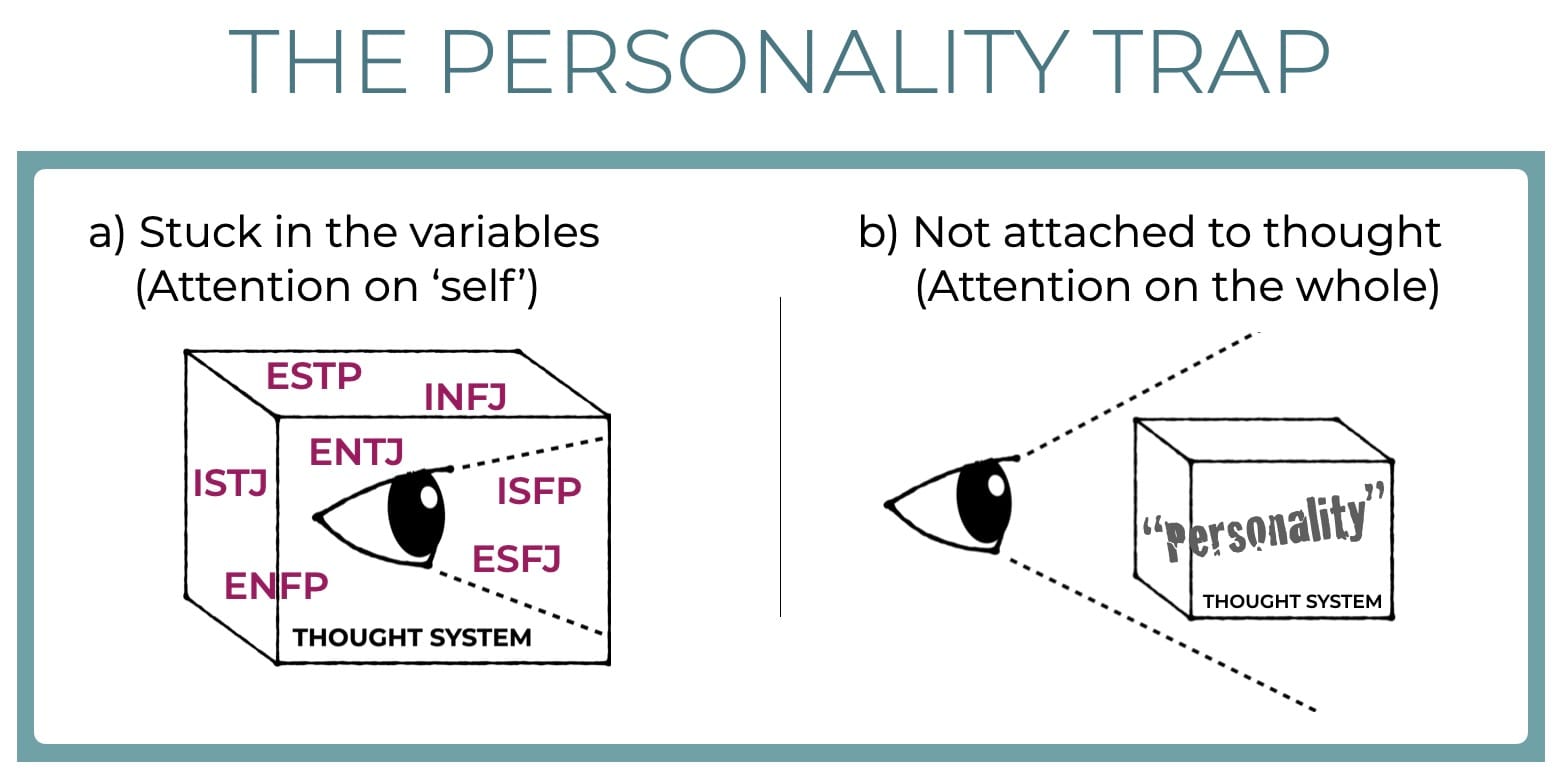
It all looks fine and dandy—and true—when we're in there, debating and analysing and pattern-matching (and answering 93 sodding questions!) but it's missing the point entirely.
Personality traits may be more fixed for some, they may be all over the place like ‘mine’, but that's overlooking one simple fact, that only becomes obvious when we pan back:
In exactly the same way as the notion of self, it's created in thought, held in place by thought and then dissolves again with thought.
And it's not the content of thought—‘personality’, in this case—that's important, it's our relationship to thought itself!
We are not our thoughts. We are the witnessing of thought.
That's the variable. That's what enables people to experience traumatic events and not be particularly bothered by them, going forwards. Not because they've somehow managed to ‘get their head round what happened’ but because they don't take thought—any of it—all that seriously in the first place.
Experiences come, are felt fully (endured, in the case of traumatic events, let's face it) and then they pass.
All is welcomed, nothing is resisted.
Which means the question that Anna poses—why do some dads struggle with life events and others don't?—may turn out to be less about personality traits than the research suggests.
Could the answer be not so much about who we think we are, but rather about our relationship to the concept of identity itself?
Hey, let's ask the newborns – they know.
😉
Giles

Want to start your days with helpful, insightful content like this? The Daily Reminder is a quick, lighthearted email that arrives in your inbox, to help keep you grounded in reality, so that you get to ‘Think less, and live more.’
“They feel like a moment of stillness in a world of madness.” ~ Neil, UK
“One of those small things with big impact. Honestly, just sign up!” ~ Paula, UK
Related
 Giles P Croft