


It's #MentalHealthAwareness week, so we've been getting a different perspective on the subject over the past few days; one that has its sights set firmly on the Innate Health within each and every one of us.
• What actually is ‘Mental Health’?
• Are we looking in the wrong direction?
• Looking upstream, to simplicity and root causes
• The role of biology in mental health
• A new definition for mental health
For consistency, I suppose we could simplify things to this:
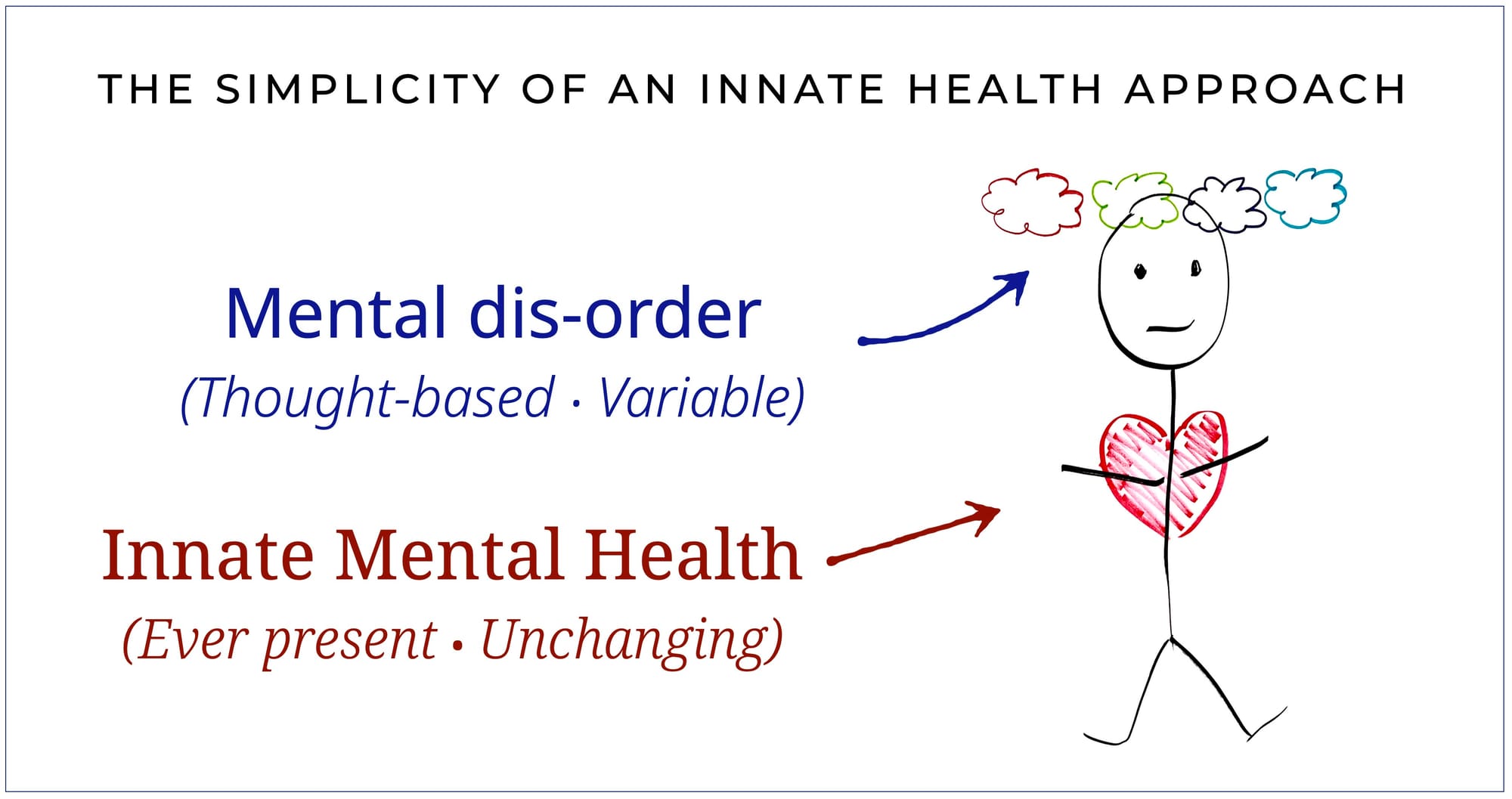
Which I suppose begs the question: where do diagnoses fit in?
I'm in the somewhat privileged position of not being constrained by ‘the system’ when it comes to diagnoses, either as a service user, or a service provider.
If you come to me for help with a particular difficulty, we're unlikely to spend much (if any) time or attention on any diagnostic label you've been given, because the fact you're seeking help with your experience means the diagnosis can't have worked.
“‘Worked’? What do you mean, worked?” I hear you ask.
Yes, from an Innate Health perspective (certainly mine, anyway), the real power in a diagnosis is when it helps someone to ‘think less, and live more’.
Because at the fundamental level, that's literally all that's going on! (Have another look at the diagram above.) And being given a diagnosis—especially if the mind's been going on safari, looking for answers—can do that.
Being told by someone ‘in the know’ that this is what we call this observed pattern of thought/feeling behaviours has the potential to come as a huge relief to a mind. (Especially if there's a lot riding on receiving said diagnosis, which, here in the second quarter of the 21st Century, sadly, it seems there is.)
But when a diagnosis doesn't ‘work’ is when it becomes an identity and/or limits what the mind says you can do. When a diagnosis doesn't work, there's a tendency for people to ‘think more, and live less’.
“Oh, I'd like to, but I can't really do that. It's my [insert diagnosis here], see?”
That's the peril inherent in a diagnosis. ‘The diagnosis trap’, as my mentor Judy Sedgeman calls it.
😞
The day I received my diagnosis
I feel like I spent 46 years seeking a diagnosis. I absolutely, unequivocally felt that there was something fundamentally wrong with me. I had all the evidence – almost half a century's-worth!
I just wasn't cut out for contentment. I was restless; always on the move. Always seeking the next thing, in a way that others didn't seem to be (minds will do that to you – thought is the great separator)!
The symptoms:
- Capricious (projects, careers and relationships)
- Short tempered
- Drank too much
- Default state of unhappiness/dissatisfaction
I bet I could have been labelled with something and/or managed to get a prescription, had I sought one out. Depression? Personality Disorder? ADHD? I dunno – make something up!
Would it have helped? Unlikely. From here, inside the Giles Ego Construct 📦 I can tell you for nothing that I'd have just used it as an excuse for my behaviour, and it wouldn't have changed a damn thing.
💁🏻♂️
And then that fateful day, almost 8 years ago, when I stood up on a stage in front of a hundred people, and had an actual experience of Innate Health, I received my diagnosis, clear as a bell:
I'd been pointed in the direction of the 3 Principles, I'd taken it on board, logically, and then a series of insights had made it all very real for me.
I saw that there was nothing wrong with me at all – I had just thought there was!
And with that, the diagnosis ‘worked’. Without really trying, I stopped thinking about my self (the Giles Ego Construct 📦) and all my (its) problems quite so much… and the symptoms gradually went away all on their own, too.
Like my thinking, I settled.
I became more patient and understanding. I stopped drinking (eventually). I relaxed into the happiness & contentment that had always been there… I'd just not noticed.
Now, I'm more than aware that bloke-has-insight-onstage-and-his-problems-melt-away is not everyone's experience. (It can't be. There's 8+ billion of us and we all have different Thought Systems!)
So I'm not suggesting your experience will (or should 🚩) look anything remotely like mine.
But here's what I will say: the diagnosis trap—the perilous aspect of a diagnosis—is made entirely of thought. Which means it isn't a life sentence or ‘just how you are’ or anything like that. It just looks that way. (And someone may have tried to tell you that.)
If you've been given a label, are seeking one, or are in a position where you assign them yourself, there's something in you—in everyone—that exists before diagnostic labels, and that a label can't touch.
That's what this whole week has been pointing to.
That's Innate Health. It's not something you earn, or build, or achieve.
It's already there.
💖
Giles
Related
 Giles P Croft
More on Diagnoses for Premium 🔖 Subscribers. Includes Audio 🎧 content.
Now available in Digital Store: the Models of Mental Healthcare Topic Deep Dive: a myth-busting 38 minutes where we cover (among other things):
- A plain-English tour of the standard ‘medical model’ of mental healthcare (Biological-Psychological-Social) and why, for all its clinical utility, it keeps us trapped, focusing on symptoms, rather than causes
- Caspi & Moffitt's landmark journal paper “All for One and One for All: Mental Disorders in One Dimension” - and the profound implications of a single general factor underpinning all mental illness
- A thoughtful ‘Inside-Out’ focused commentary piece on the article, from 3 Principles teachers Kelley, Pettit, Pransky & Sedgeman, that takes these scientific findings one step further
- What the Innate Health understanding has to say about the root cause of all psychological suffering
- Why the answer lies in simplicity, not ever-increasing complexity… and what that means for mental healthcare in practice.
This isn't a critique of psychiatry for its own sake. It's an invitation to look in a genuinely fresh direction – one with profound implications for how we understand suffering, and what we can actually do about it.