


It's #MentalHealthAwareness week, so we've been looking in a different direction over the past few days: away from disorder, and towards health; away from complexity and towards simplicity; away from symptoms and towards causes.
• What actually is ‘Mental Health’?
• Are we looking in the wrong direction?
• Looking upstream, to simplicity and root causes
• The role of biology in mental health
Which leaves us in a place where we're ready to consider a new definition for mental health; one that epitomises all of that, above 👆🏻
I share it in this short (<2 min) video clip, lifted from a session I ran, all about the different models of mental healthcare:
You can get hold of the full video, which is now in the online store, below
Towards the end of the clip, you'll see an overlay that pops up, that I want to draw your attention to, because there's something super-important about it.
It says: “Awareness of the mind” and the reason that's significant is because when a mind hears someone like Mark Howard defining mental health as:
“Contentment with what is”
…it can very easily make a hop, skip and a jump and conclude that “what is” means situations and circumstances, and it's not that. Not really.
That would be the mind, trying to accept something (and causing more upset in the process).
It's a deeper ‘contentment’ than that; one that is summed up in that Sydney Banks quote that appears at the bottom of every Daily Reminder email:
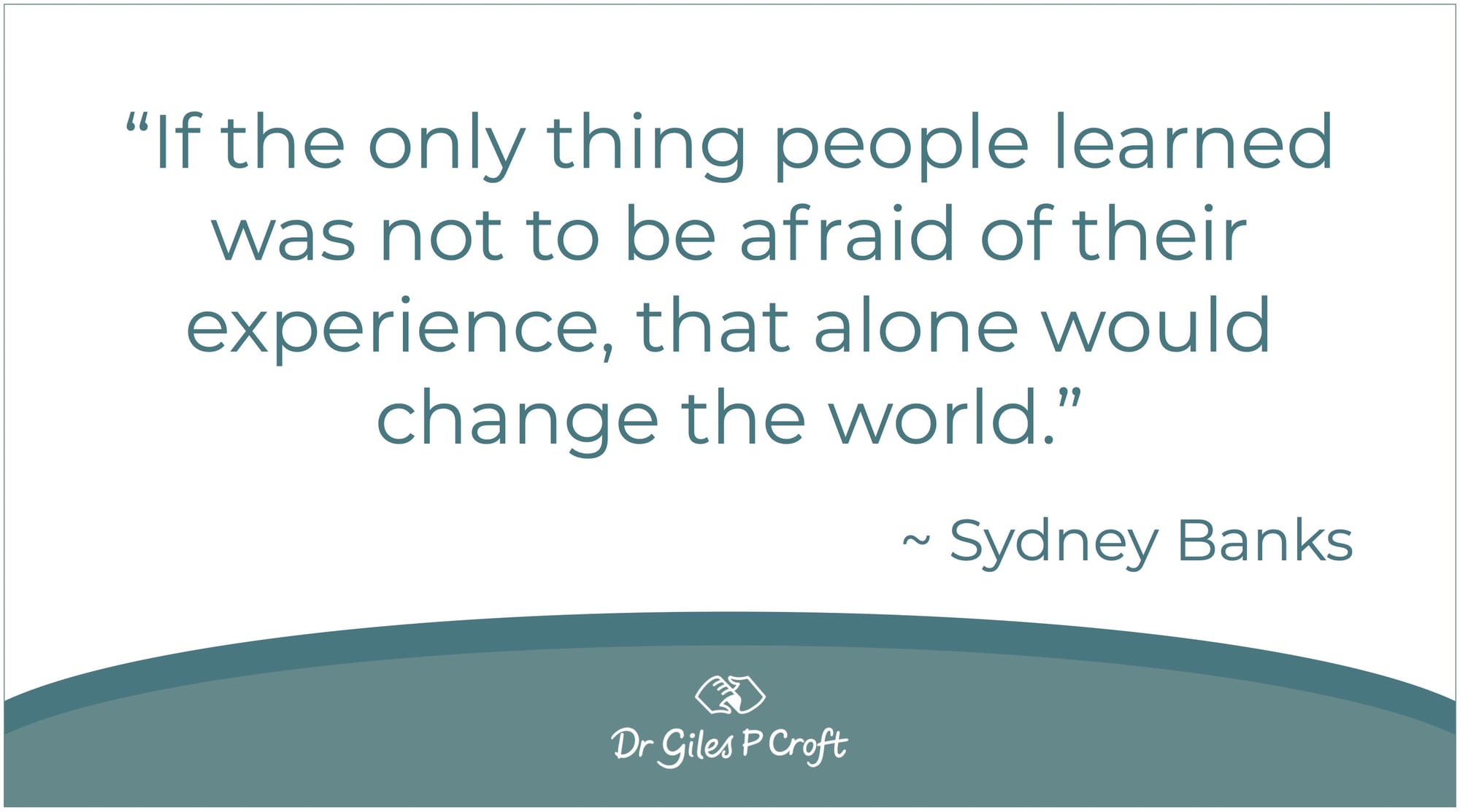
Look again at that diagram in the video and you'll note that “what is” includes the mind and all its responses, which is why I say “Awareness of the mind” rather than leading you up the garden path by suggesting that you're going to somehow check out of the human experience and ‘get rid’ of your blabbering mind entirely.
Forget it.
Mental health is being at peace with the mind.
💞
Giles

This clip was taken from the Models of Mental Healthcare Topic Deep Dive: a myth-busting 38 minutes where we cover (among other things):
- A plain-English tour of the standard ‘medical model’ of mental healthcare (Biological-Psychological-Social) and why, for all its clinical utility, it keeps us trapped, focusing on symptoms, rather than causes
- Caspi & Moffitt's landmark journal paper “All for One and One for All: Mental Disorders in One Dimension” - and the profound implications of a single general factor underpinning all mental illness
- A thoughtful ‘Inside-Out’ focused commentary piece on the article, from 3 Principles teachers Kelley, Pettit, Pransky & Sedgeman, that takes these scientific findings one step further
- What the Innate Health understanding has to say about the root cause of all psychological suffering
- Why the answer lies in simplicity, not ever-increasing complexity… and what that means for mental healthcare in practice.
This isn't a critique of psychiatry for its own sake. It's an invitation to look in a genuinely fresh direction – one with profound implications for how we understand suffering, and what we can actually do about it.
Related
 Giles P Croft
Looking at a deeper kind of acceptance