


Last week, in the final* part of my 4-part mini-series on the nature of insight, I provided some links to research that had been conducted around the Innate Health understanding.
If you've had any dealings with the world of academia in the past, and you followed your curiosity, you might have noticed that a lot of the papers were in quite small, somewhat esoteric-sounding journals. And you may have been left wondering why there wasn't more mainstream, traditional coverage?
Publications of note
It's fair to say that I have had many dealings with the world of academia, and from that perspective, some of my personal favourites (with links to the full PDF versions) are:
- A new “inside-out” perspective on general factor p (European Psychiatry, 2019) - a great commentary piece from a respectable publication, in response to a landmark paper from the American Journal of Psychiatry
- A superpower? An educational initiative? Or something else…? (Journal of Public Mental Health, 2017) - Michael Neill & Anthony Kessel with a great overview of the 3Ps in a recognised publication
- Innate Health: A Novel Examination of What Explains Well-Being, Prosocial Behavior, and Aggression Among Men Living in a U.K. Prison (Criminal Justice and Behavior, 2024) - a recent paper from the amazing team at Innate Health Research
- Health Realization Community Coping Intervention for Somali Refugee Women (Journal of Immigrant and Minority Health, 2019) - great results with PTSD
- Three principles/innate health: The efficacy of psycho-spiritual mental health education for people with chronic fatigue syndrome (Spirituality in Clinical Practice, 2020) - ditto, with Chronic Fatigue Syndrome
- Reconnect to Innate Resilience: Summary of Results & Impact (My own research, 2023) - conducted when working with Social Care staff during the Covid pandemic.
An obvious answer
I confess, with my medical background and hunger for evidence, when I first came across the 3 Principles, I was a little disappointed by this state of affairs, that is, until I read the book Sanity, Insanity, and Common Sense (1980).
It is indeed rammed with forehead-slapping common sense and if you ever sit down with it, you'll wonder why it's not obligatory reading for every human that inhabits planet earth. (The world'd be a better place.)
When it comes to research into wellbeing and mental health, they don't mince their words. In a section titled The Myth of Information, they say:
“More information about what we do not understand is of very limited value.”
Oh, ok. 😳
“In the absence of recognizing that thinking is the formulator of people's experience, the mental health professional has gathered more and more information regarding people's problems. The study of human behavior comes up with more causes, more types of traumas, more neuroses, more syndromes and more categories and classifications of disturbances [but] … the answers that we seek elude us.”
(There are echoes of the Caspi & Moffit 2018 paper, All for One and One for All: Mental Disorders in One Dimension here – we're busy delving into the symptoms of mental distress, without looking at the singular root cause: a misunderstanding of the nature of thought.)
They then highlight that every theory of psychology, and all the mainstream, traditional research that is done, is built on a fundamental misunderstanding (the outside-in illusion). Which of course will come up with internally valid results, but that serve only to further reinforce that misunderstanding, because:
“All psychological theories are in themselves systems of thought … We are measuring ourselves with our own theories, models and assumptions.”
😬🤦🏻♂️
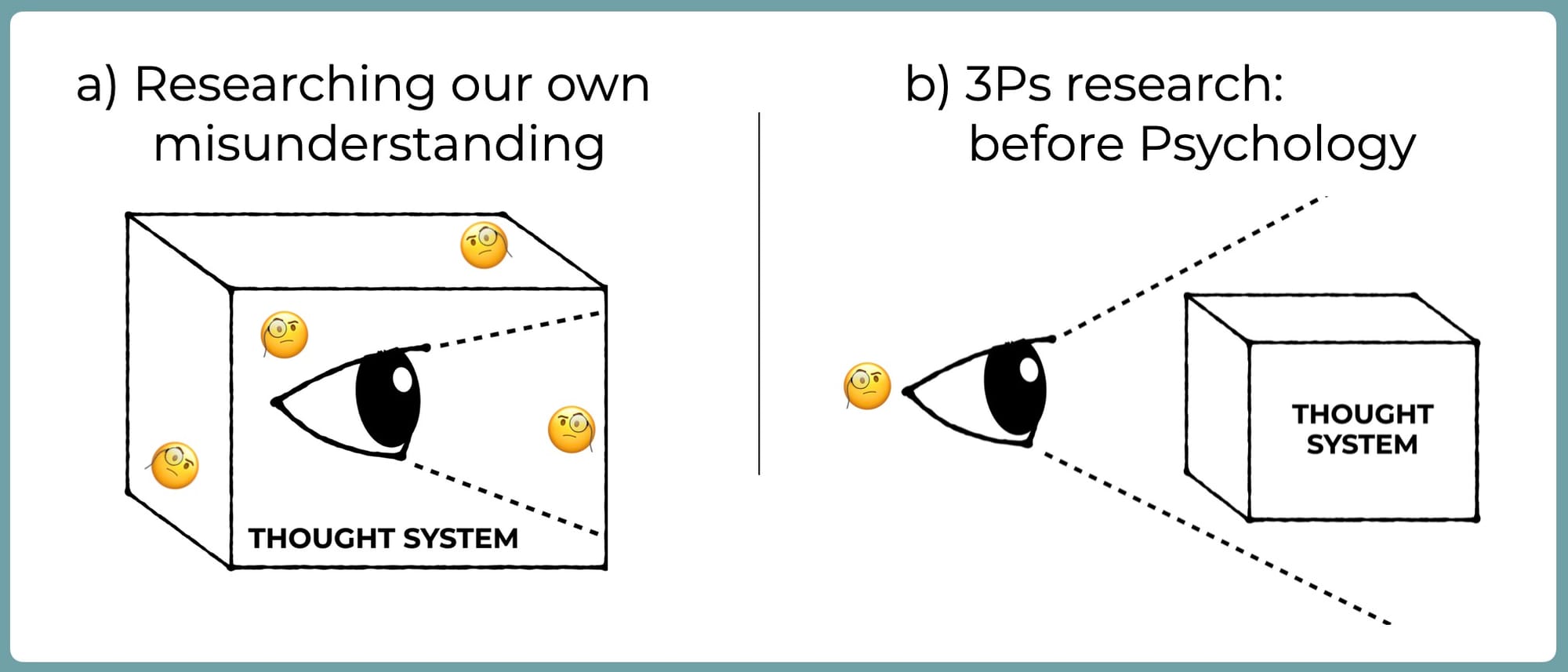
This is why I said, in the earlier piece: “Measuring something that, to all intents and purposes, is invisible, is not entirely straightforward!”
An illustration
To illustrate, in the book Sanity, Insanity & Common Sense, they use the example of the early (pre-Copernican, geo-centric) astronomers, who constructed a vast canon of scientific, objective measurement of the observable heavens. And, as a result, equally abundant works of perfectly ‘correct’ (i.e. internally-valid) theories and models to explain the movements of the stars and planets.
So far, so good. It was all accepted knowledge, even if some of the theories got a bit complex, the more detailed they became (for instance, they tied themselves in knots trying to explain why planets like Mars and Saturn appeared to loop back on themselves, as they orbited the earth).
There was only one problem with all this scientific ‘knowledge’ - it was nonsense! The fundamental assumption—i.e. that everything was revolving around the earth, in a geo-centric system—was wrong, therefore, no matter how ‘valid’ the research and the theories were, they weren't a reflection of what was actually going on.
The study of Astronomy was in its ‘pre-paradigm’ phase, therefore there were a lot of theories but no real understanding.
Once Nicolaus Copernicus demonstrated that we actually live in a helio-centric system (i.e. all orbiting around the sun), everything became much more simple and the movements of the planets suddenly all made sense.
That's how Principles work, folks!
A parallel
I'll hand back over to the book authors, Rick Suarez, Roger Mills & Darlene Stewart for that:
“The field of psychology is in the same predicament as the early astronomers. Although sincerely attempting to find solutions for psychological problems, the field has been unable to provide simple, consistent answers for human psychological difficulties … A breakthrough has not occurred because the answers to the riddles have nothing to do with the objectivity of our research, but rather with the underlying assumptions of our questions.”
Until, as a species, we collectively see through the outside-in misunderstanding, psychology too will remain in its pre-paradigm phase. Which means there will continue to be a lot of theories, but no real understanding.
😔
But take hope:
“The way out of the confusion is simple. It is difficult to grasp only because our present thinking will not point outside of itself … In order to evolve to something beyond what we already think, we must look beyond the information, theories, assumptions and methods that are the form this thinking has taken … setting aside the current psychological frame of reference in order to see something beyond it. At this point, psychology will break through to become the most potent source of mental help that this culture has ever known.”
I'm totally up for that – are you?
💟
*p.s. There was a sort of bonus, 5th part, where I outlined one common pitfall to avoid
p.p.s. …and a 6th! 🤦🏻♂️

Want to start your days with helpful, insightful content like this? The Daily Reminder is a quick, lighthearted email that arrives in your inbox, to help keep you grounded in reality, so that you get to ‘Think less, and live more.’
“They feel like a moment of stillness in a world of madness.” ~ Neil, UK
“One of those small things with big impact. Honestly, just sign up!” ~ Paula, UK
Related
 Giles P Croft
In which I mention the research. (You can catch the whole series here.)