Last week, I ran a series of Daily Reminders, all on the topic of Mental Health.
And in one of them (A new definition for Mental Health) I mentioned something that I've been meaning to come back to ever since I wrote it.
Because it's so important. But really easily misunderstood. I said:
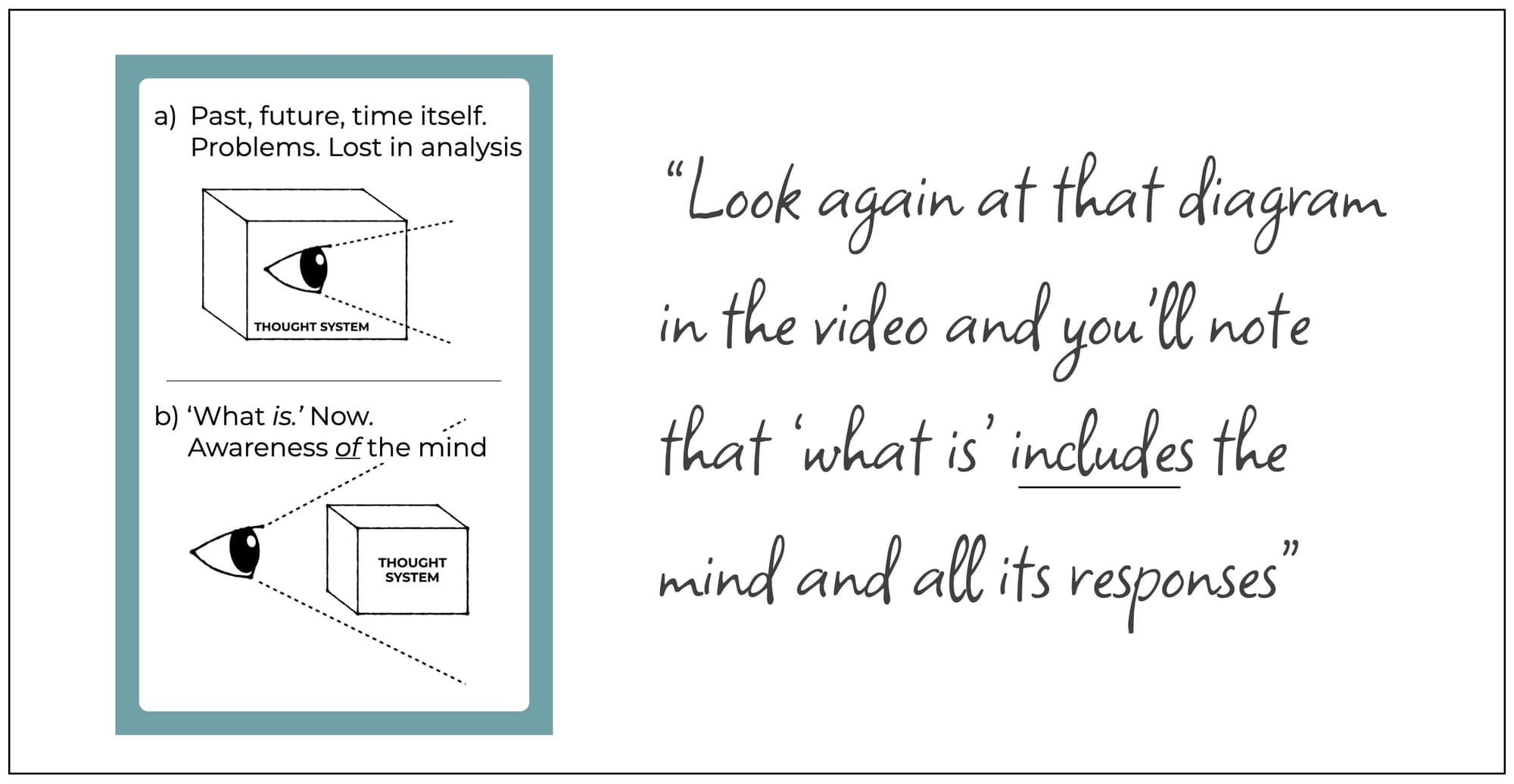
“Look again at that diagram in the video and you'll note that ‘what is’ includes the mind and all its responses”
So let's just settle down for a moment and get clear on the implications of that. Because probably the most common presentation I see with clients is that they're having an experience they don't like, that they want to change. For instance:
- anxiety or unease, after a previous situation that's now passed
- upset or strong emotions, in particular circumstances
- extreme sadness, when recalling an event from the past
- urges to behave in a particular way, when faced with a certain state of affairs.
And, very naturally, the desire is to change that experience. Make it different. Stop the flashbacks. Mitigate the emotions. Suppress the urges.
But that's only because they look separate from the situation. It's like there's ‘situation’ over here → 🏡
😫 ← and ‘response’ over here.
But the two aren't separate. They are literally one and same thing, because:
100% of it is thought-created: it's all going on within.
Therefore our ‘response to the situation’ (the phrase itself of which implies separation) is in fact the situation.
That's it. That's what you're getting. It's the whole situation, as it arises in consciousness.
Revisiting quotes
I'll be honest, my poor little mind starts to go into meltdown if I think about this one too hard, so let's just re-examine three famous quotes—all of which I think I've probably trotted out before—and look at them from this perspective:
1. Sydney Banks
“If the only thing people learned was not to be afraid of their experience, that alone would change the world.”
This one appears at the bottom of every email I send out. But what's your understanding of the word “experience”? Is it just the stuff that happens… or does it include the mind's response to situations, which actually is the situation?
How would that change the meaning of the quote?
🤔
2. Jiddu Krishnamurti
“My secret? Oh, I suppose you could say, I don't mind what happens.”
On the surface of things, this looks like a classic case of (somewhat passive) acceptance. ‘Oh well, bad shit's happening, who am I to complain?’ But what if “what happens” incorporates the mind's response to a situation (which is the situation)?
Would that shed a different light on this saying?
🤔
3. Stephen Covey
“The way you see the problem is the problem.”
My first exposure to this notion, and it completely passed me by (as did a lot of Stephen Covey's 7 Habits of Highly Effective People, that I suspect was actually a bit deeper than my eager reading of it).
I always used to think that this meant ‘There is a problem. And you need to change your perspective on it, in order to move forward’ (by reading this book, lol), but now I'm not so sure.
What if it's literal? Something more like: No, the ‘problem’ (if there even is one) is the mind's response to things. Because that's all you get. That is the situation.
🤔
The result?
Well, everyone's got different stuff going on, and a Thought System 📦 full of their own experiences, so the details will be different for everyone, but the underlying principles are the same for everyone and there's something about seeing the depth of this—of appreciating that there is no situation and response; there's just ‘this’—that has a tendency to shift things for people.
Not in a way where you can plan for how-to-behave, the next time you're in said situation (doesn't work like that; please stop trying!), but in the mind-body simply responding differently next time you encounter it.
(Maybe this is what they mean when they say that “nothing's different, but everything's changed” – you may not even notice the ‘problem’ any more!)
To a mind, that aches to have its fingers in all the pies, this will probably feel less-than-satisfactory. Maybe a tad frustrating.
And when you catch that this feeling too, is the situation, well then, you're on the right track to it all changing for you.
😘
Giles

Want to start your days with helpful, insightful content like this? The Daily Reminder is a quick, lighthearted email that arrives in your inbox, to help keep you grounded in reality, so that you get to ‘Think less, and live more.’
“They feel like a moment of stillness in a world of madness.” ~ Neil, UK
“One of those small things with big impact. Honestly, just sign up!” ~ Paula, UK
Related
 Giles P Croft