In advance of having a recorded conversation with a colleague, on the topic of work relationships, I thought I'd do some homework.
(Now my daughter’s at big school, it’s bringing back all sorts of memories, and I’m starting to appreciate that I’m a swot at heart! 🤓)
See, I had a vague recollection of having read something really helpful, about work relationships, in my all time favourite book*, that I’ve not read for a while.
(so 📚 many 📚 books 📚 to 📚 read)
So I picked it up and refreshed myself, over my morning coffee.
In the chapter entitled Application of Psychological Principles to Organizations, there’s a Case Study of ‘Alan’ – a manager who everybody sees as a difficult boss.
He’s doing his best, but is finding it difficult to get the most out of his staff, because they’re a bit incompetent and they don’t really listen to him. Which he can’t understand, because he’s really, really trying to help them.
Consequently he hates his job. As do all of his staff. And stuff’s beginning to slip through the cracks as a result of this general work-misery.
It’s fascinating and funny. Like all good 3 Principles Case Studies it starts off with everything-is-terrible and ends up with everything-is-awesome. His staff make a big turnaround, he has much better relationships with them and actually gets overheard telling another manager,
“This has been the best year of my career!”
So what the hell happened in the middle?!?!
Well, much to his confusion, he wasn’t given any techniques to use (he’d had a whole career, climbing the corporate ladder, learning a bunch of techniques; some of which sometimes worked) and instead was invited to explore how his experience (of everything) is being created, and how moods, and insecurity affect his ‘reality’.
🧐
Of course, like most people first introduced to this understanding, his initial response was:
“And…?”
…but to his credit, he stayed open and over time, as his understanding deepened, things started to change.
There were two sentences in the story that had me voicing my approval out loud and reaching for my pencil to underline and put big asterisks next to, that I’ll share with you here.
The first points to the fact that these Principles are Universal (i.e. in play 100% of the time; no exceptions). Because although applicable to his work situation, and vastly improving his work situation once they’d been seen, it was actually at home that they first started to make sense to him. As manifest thus:
📔 “When his wife was in an off mood, or if she was complaining about something, he was finding he would rather fix her a cup of tea, than argue.”
😂🤣
I love that! Tea FTW! 🙌🏻 🫖
Note what this doesn’t say: that he used ‘making tea’ as a technique to get his way, improve their relationship, or even to ‘make her feel better’. No, simply that “he was finding he would rather…” which is pretty much how this stuff works.
The other sentence I really loved speaks to the ‘inside-out’ nature of relationships (i.e. the fact that we’re not experiencing other people, we’re experiencing ourselves, reflected outwards):
📔 “He sees people differently, because he sees himself differently.”
😍😍😍😍😍😍
Yes, yes, yes and a thousand f***ing times YES!!!!
You cannot change other people… other than by more deeply understanding your own psycho-spiritual make-up.
(It’s an inside-out reality we live in, so it’s the only way.)
And when you do that… your entire world changes completely.
💖
Giles
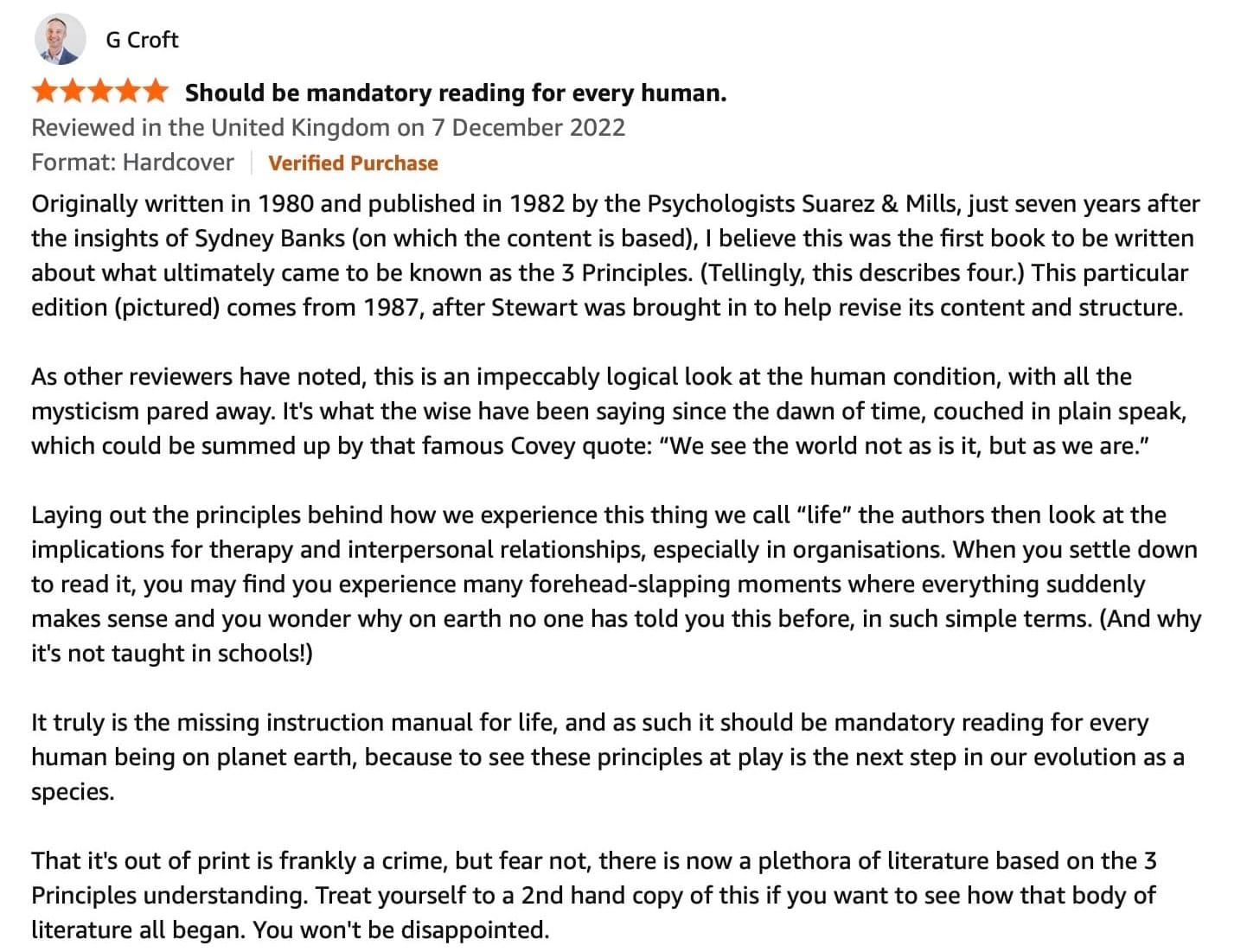
*p.s. before I get inundated with emails: Sanity, Insanity and Common Sense by Rick Suarez, Roger C. Mills and Darlene Stewart. Good luck finding a second hand copy on eBay or Amazon. 🍀👊🏻
To whet your appetite, here's my totally biased review: