


My wife forwarded on to me some interesting research that suggested it might be a good idea to talk to your self. And given that Me and the Giles Ego Construct 📦 go back a long way—a relationship that can get quite vocal at times—my ears pricked up!
Published in Nature Journal, the researchers found that when people reflect on negative feelings in the third-person (i.e. using their name, rather than “I” language), it reduced emotional brain reactivity.
It was all done with fMRI brain scans and complicated-sounding things like ‘event-related brain potentials’ so its real-life application should be taken with a rather large pinch of salt, but the researchers got most excited because they think they've found an easier way to regulate emotions.
At the outset, they state,
Emotion regulation, as with many forms of self-control, is typically thought of as an effortful process that depends heavily on cognitive control mechanisms to muffle emotional responses.
…which unless I'm wrong is their way of saying “Life is hard! And you need to work hard at not feeling bad, people!!” 🙄
(And what's with ‘muffling emotional responses’?! Whatever happened to ‘It's ok to not be ok’?!)
So near and yet…
As with all these kinds of well-meaning, popular psychology experiments, they make sense because they're circling round deeper truths, that have gone unnoticed, or unmentioned.
I could pull out loads of reasons why this study makes sense from a 3 Principles perspective, but in this case, I'd say the main one would be:
The more we identify with thought, the further we stray from our true identity, and the harder life will seem.
(You don't need to be a neuroscientist to observe that when you're present to life and not ruminating on all the mind's problems that it's making for itself, everything flows a lot easier!)
So any steps one can take in getting some distance from the uninvited guest in your head, is going to help – including referring to oneself in the third person!
But without that deeper insight—that who we really are is actually before thought—it would be very easy to start identifying with the thinking that's ‘getting some distance’ from the other bit of thinking that it doesn't like… and it all gets very complicated and messy, very quickly.
😵💫
Which is why, while it's a nice theory and all, I suspect not many people will have derived much actual benefit from talking about themselves in the third person, unless they've seen that all identity is a creation of thought.
After that, one kind of starts taking one’s ‘self’ a lot less seriously anyway – you don't need to cope with, talk-away, or ‘get some distance’ from something that's not real.
🤷🏻♂️
Anyway, for me there's a more fundamental problem with research like this, and it's the whole emotions-are-to-be-muffled thing.
Had they ever stopped to consider that trying to manage and control our experience is exactly the thing that makes life look hard in the first place?!
I'm going to have to bring out the big guns here again, aren't I?
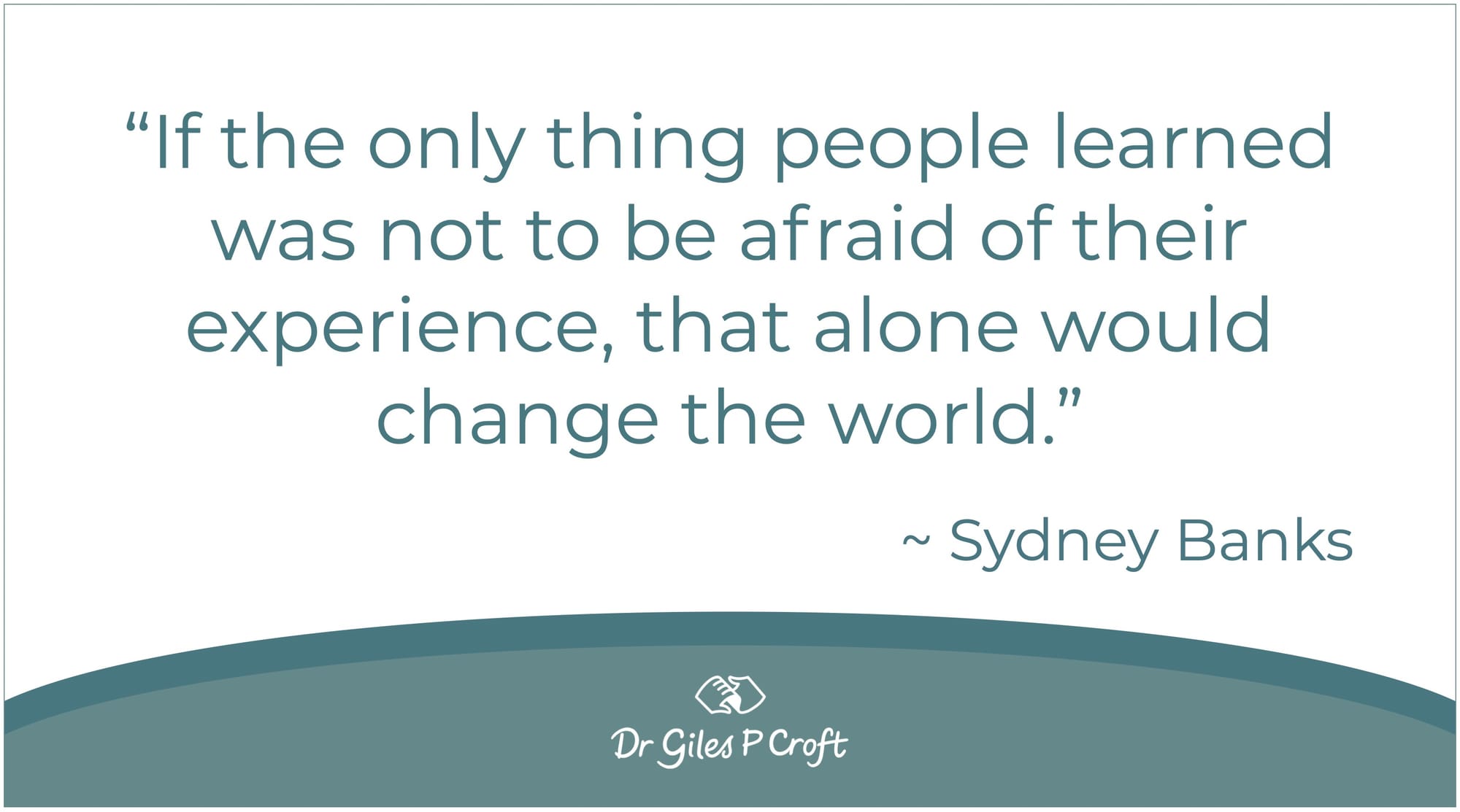
💟
Giles
p.s. It did occur to me though, that if you're ever needing to provide someone with supporting evidence for the 3Ps, you could add this study to your toolkit. Might be a good way of starting the conversation!