In a recent Daily Reminder, we looked at two different kinds of thinking experience—‘wisdom’ and ‘worry’—and how to differentiate between them, by feeling.
(Probably worth having a quick watch of the video, if you missed it; it’s only 3 minutes long.)
And today, I want to take a Sunday-look at where it’s so easy to trip up around this idea.
Because have you ever caught yourself saying something like,
“I just need to trust my inner wisdom”?
Because it’s an easy hop, skip and a jump from seeing a difference between the felt experience of wisdom/intuition and the felt experience of worry/over-analysis; to seeing one as ‘good’, the other as ‘bad’ and therefore aiming for one, over the other.
You know, turn it into a strategy.
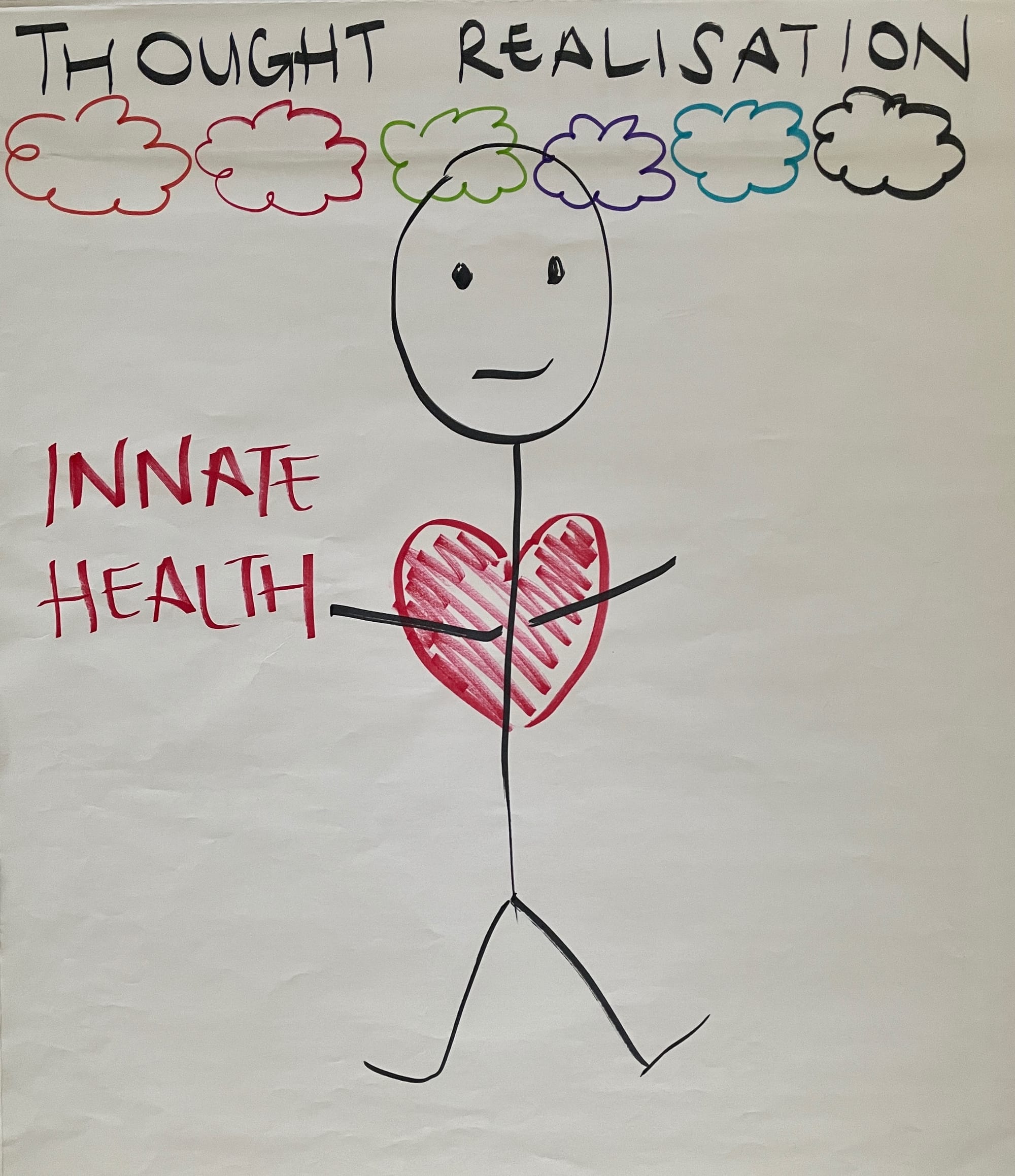
And nobody would blame you if, all the the while you did this, it was playing out to the visualisation of my little Thought Realisation/Innate Health stick man diagram:
But guys. We need to look more closely at that sentence:
“I just need to trust my inner wisdom”
For a start, whose wisdom are we talking about here?
Because I’m not sure ‘wisdom’ is yours. It just is. It’s the formless, intelligent energy of life itself.
To refer to it as ‘your’ wisdom would be a bit like leaving the house and trusting to ‘your’ gravity.
Not a thing.
Then there’s the whole issue of trusting said formless energy.
Trust implies ‘good’ and ‘bad’ outcomes. It’s like there’s an unwritten, or invisible equation that goes something like:
Instead, I get caught up in over-thinking (which is bad).
Therefore I don’t get the good outcomes that would have happened if I had just ‘trusted my wisdom’.
I make un-wise decisions and I get bad outcomes.
Woe is me. 😫
I hope you can see the nonsense in this, too.
It’s all conceptual. All intellectual. It all actually lives in the Thought part of the equation.
And it’s all predicated on a ‘me’ that gets to choose these things; a ‘me’ that’s actually no more than a recurrent habit of thinking in itself.
Crucially: a ‘me’ that thinks its needs will be met if things turn out a particular way—if wisdom is trusted!—and then, finally, everything will be ok. The relentless search will be over. It can stop worrying.
It will shut up for you then, and leave you alone, honest.
🙄
Again, not a thing.
It’s a prison. A trap. “Trying to find love where the beautiful bird does not drink,” as Hafiz would say.
For as long as ‘you’ (i.e. the mind) keep trying to figure this out and put some kind of strategy into action, you will remain stuck.
One of the most useful stories I ever heard related about Syd Banks was that he would use concepts, but only up to the point where it allowed the listener to let go of concepts. To lull the mind to sleep and rest in the peace of pure presence.
It’s why I chuck one metaphor after another at you in the Daily Reminders: here, try this… and this… and this…
Not for you to understand them, remember them, or apply them, but for that one moment where something I’ve written hits you in the feels so hard that you drop ALL the thinking you have about this stuff (including notions such as ‘trusting your wisdom’) and have a very real experience of who you are, before concepts, labels or stories.
With so much love.
💟
Giles
Mentioned above
 Giles P Croft