


I continue to read Linda & George Pransky's excellent book Unbreak Your Heart, which is all about relationships. The subtitle is For Couples Who Don't Want To Break Up and in a way I wish they'd called it something else, because while it would definitely be of use to people in such a situation, really it's about relationships in general:
- Parent-child
- Family members
- Work colleagues
…anyone you interact with on a regular basis, and have to get on with, basically.
It gets a strong recommendation from me. It's so jam-packed with good old fashioned common sense, it's super-helpful to humans full stop, and you shouldn't be put off reading it, just because you're not thinking of splitting up with your partner sometime soon! Check it out:


Mood-awareness
Anyway, I just got to the chapter on dealing with irritations, and they start talking about how moods affect the way that irritations look. They state, quite simply:
“Just like our thinking can drop when our spirits drop, how you respond to irritations can be stronger when you are in a low mood.”
💡 Useful to know!
They then explain how irritations are a “barometer for your mood” – i.e. the ‘irritating’ behaviour doesn't change, but we are bothered more, or less by a behaviour, depending on our state of consciousness in that moment.
(It's inside-out 101! And one of the reasons I rate this book so highly.)
But the bit that really grabbed me was when they mentioned a client who told them that she's mostly unaware of her mood, unless she's driving, in which case she's totally in tune with where she's at:
- easily annoyed about how fast or slow other people are going → Low mood 🚨
- smiling at other drivers, letting them in before her → Good mood 😀
I love that she could identify this, in a low-stakes environment, because it's when the stakes are raised that this awareness really comes into its own.
Why is this important?
Because the way you see the world, and situations and other people is a function of your level of consciousness.
Just like I pointed out in yesterday's Daily Reminder:
- In a low mood → things naturally look worse, we're more easily irritated, and we take everything really personally (i.e. interactions are ego-driven)
- In a better mood → we're not so reactive to situations, see things from a loftier perspective and don't take things personally (i.e. interactions are love-driven).
And don't forget, there are two of you in every interaction, each either coming from a place of ego, or from love.
It's like this is going on all the time:
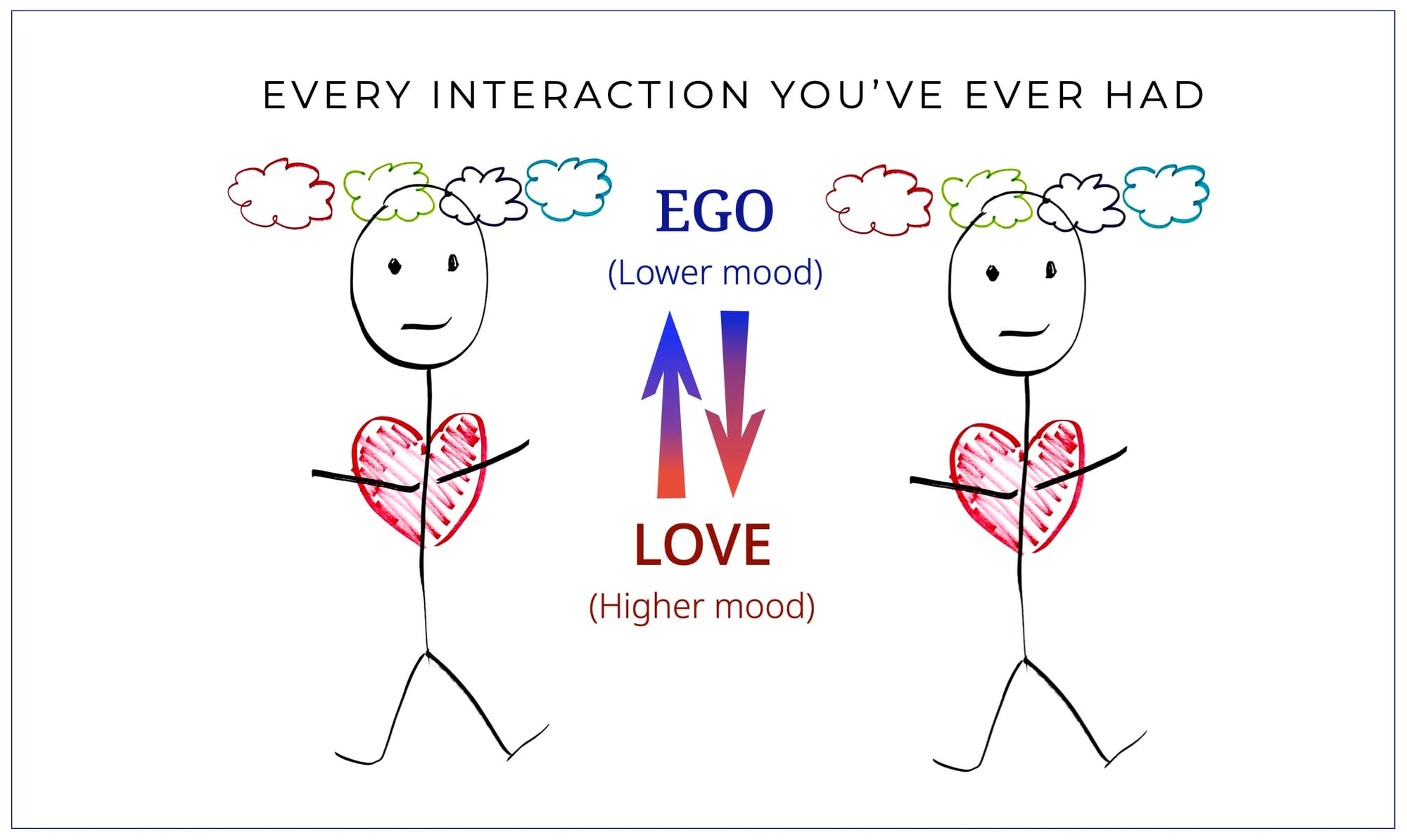
And being in tune with where you're at on this scale (and consequently where they're at) is absolutely essential if you're going to keep from falling out and having ego protect its turf by doubling down on all its insecurities.
(Usually with shouting, or tears.)
This is one of those super-simple things that makes a really big difference to your everyday life. Because we can learn to distrust our low-mood thinking, and ‘let cooler heads prevail’.
As Richard Carlson says, in a section of one of his books entitled Don't Try to Solve Your Problems in a Low Mood:
“Respect the power of a low mood… you won't see things differently while you are in one. But you can learn to distrust yourself and the thoughts you generate when you wind up in a low mood.
“If a genuine problem exists when you're low, don't worry – it will still be there when your mood level goes up. And when it does, you will be better equipped to deal with it.”
💝
Giles

Want to start your days with helpful, insightful content like this? The Daily Reminder is a quick, lighthearted email that arrives in your inbox, to help keep you grounded in reality, so that you get to ‘Think less, and live more.’
“They feel like a moment of stillness in a world of madness.” ~ Neil, UK
“One of those small things with big impact. Honestly, just sign up!” ~ Paula, UK
Related
 Giles P Croft
Practical advice for what to do when you spot it.